
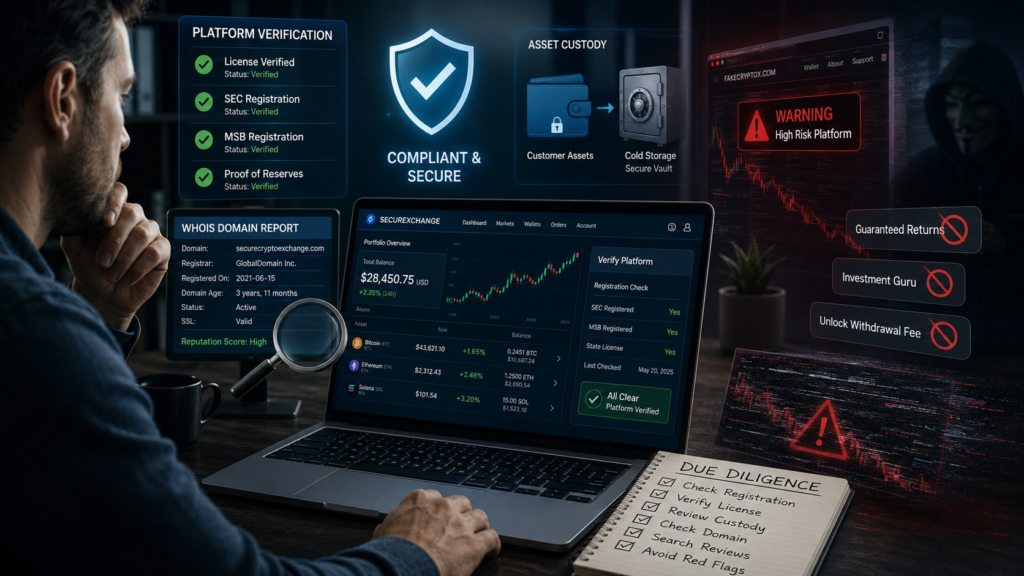
Most people who lose money to a fake crypto platform don’t lose it to a hack. They lose it because the platform never traded anything at all. In December 2025, the SEC charged three “trading platforms” — Morocoin, Berge, and Cirkor — that had recruited investors through WhatsApp investment clubs run by fake “professors” and “assistants.” The complaint alleged the platforms falsely claimed government licenses, fabricated account balances, and had never actually executed a single trade. Investors lost at least $14 million before the sites went dark. That pattern — a polished-looking platform, a claimed license nobody checked, and a withdrawal that never happens — repeats constantly, and it’s checkable in advance if you know where to look.
This guide walks through the four things worth verifying before you deposit anything: who’s actually licensed to hold your money, what happens to your crypto once you send it, how old and how “real” the platform actually is, and the specific language patterns that show up in fraudulent offers.
Check Registration Before You Check Anything Else
In the U.S., a platform that lets you buy, sell, or trade crypto assets that qualify as securities generally needs to be registered with the SEC or operating through a registered broker-dealer, and firms offering investment advice need to be registered too. You can check this directly:
- Investor.gov lets you search by firm or individual name to see if they’re a registered broker or investment adviser, and it shows disciplinary history.
- FinCEN’s MSB registrant search shows whether a company is registered as a Money Services Business, which most legitimate crypto exchanges operating in the U.S. are required to do.
- Most U.S. states also require a money transmitter license for platforms that custody customer funds — check your state’s Department of Financial Institutions or equivalent regulator.
A platform claiming “SEC-licensed” or “government-approved” status is a claim, not a fact, until you’ve verified it against one of these registries yourself. The SEC’s December 2025 complaint against Morocoin and Berge noted that both sites falsely claimed regulatory licenses they didn’t have — a false claim is often more convincing than no claim at all, because it discourages further checking.
Understand Custody Before You Deposit
Once you send crypto to a platform, the question of who actually controls it matters more than almost anything else. The SEC’s investor education office distinguishes between platforms that hold assets in your name in segregated wallets versus platforms that commingle customer funds — the latter structure is what let FTX and similar collapses turn a liquidity problem into a total loss for depositors. Before funding an account, look for clear, specific answers to:
- Does the platform hold customer assets in segregated, named wallets, or in a pooled/omnibus wallet?
- What percentage of assets is held in cold storage (offline) versus hot wallets (connected to the internet)?
- Does the platform publish independently audited proof-of-reserves, or does it just claim to?
- Who is the actual custodian — is it self-custodied by the platform, or held by a third-party qualified custodian?
Vague answers (“bank-grade security,” “military-grade encryption”) without specifics on wallet structure or audits are themselves a signal. Legitimate custodians name their auditors and publish attestation reports; they don’t just use security-adjacent adjectives.
Read the Domain Like Investor.gov Does
Domain age and registration pattern are minor signals individually but compound quickly. Investor.gov’s PAUSE program — built specifically to flag firms and fictitious “regulators” — treats claims of regulatory approval that can’t be verified as a primary red flag, and fraud-tracking firms have separately identified networks of thousands of fake-news-style sites used specifically to promote investment fraud through paid ads and syndicated “reviews.” A few checks take under five minutes:
- WHOIS lookup: How old is the domain? A platform claiming years of track record on a domain registered months ago is a direct contradiction worth investigating.
- Search the platform name plus “review” or “scam”: If the only results are templated, near-identical “how to buy crypto on X” articles published across unrelated blogs in the same few months, that’s a paid content campaign, not organic reputation. Genuine platforms accumulate a messier, more varied trail — complaints, forum threads, news coverage — over years.
- Check a trust-score aggregator (ScamAdviser and similar tools look at domain age, registrar reputation, and SSL setup) as one data point, not a verdict on its own.
- Look at the registrar. Some registrars have a disproportionate share of fraud-associated domains; that alone isn’t proof of anything, but combined with a young domain and unverifiable licensing claims, it adds up.
Language Patterns Fraud Regulators Flag Specifically
The CFTC and SEC’s joint investor alert on fraudulent crypto trading sites lists specific language patterns that show up disproportionately in fraudulent offers, including guaranteed high returns (frequently in the 20–50% range) paired with claims of little or no risk, and unsolicited pitches that arrive through ads or group chats rather than something you sought out. Watch for:
- “Guaranteed” returns of any kind. Legitimate investments carry risk; a platform that promises otherwise is either lying or doesn’t understand what it’s selling.
- Advance-fee requests to unlock a withdrawal. In the Morocoin/Berge/Cirkor case, once investors tried to withdraw, they were told they owed a “tax” or “fee” first, or that their account was frozen pending a fake investigation — a pattern the SEC has documented across dozens of similar cases.
- Group-chat or DM-based “signals.” The SEC’s December 2025 investor alert specifically warns against relying on investment advice from group chats run by unknown “financial gurus” or “professors,” a structure that’s become common enough to get its own dedicated alert.
- Jargon-heavy explanations that don’t actually explain anything. Regulators note that overly technical or confusing pitches often exist specifically to discourage questions, not to inform.
A Practical Pre-Deposit Checklist
Before funding any account:
- Search the firm and any named individuals on Investor.gov’s registration check.
- Search the company name on FinCEN’s MSB registrant list.
- Run a WHOIS lookup on the domain and note its registration date.
- Ask the platform directly: segregated or pooled wallets, cold storage percentage, and name of the auditor for any proof-of-reserves claim. A firm that can’t answer specifically hasn’t earned your deposit.
- Search for the platform name alongside “SEC” or “CFTC” to check for existing enforcement actions or investor alerts.
- Treat any guaranteed-return promise, advance-fee withdrawal request, or unsolicited group-chat pitch as a stop sign, not a detail to look past.
None of these checks are exotic — they’re the same checks a compliance analyst runs, made available for free through public regulator tools. The reason fraudulent platforms survive isn’t that the checks are hard to do; it’s that the pitch is designed to make you feel like doing them would be rude, slow, or unnecessary given how “obviously legitimate” everything looks. A platform confident in its own legitimacy has no reason to make verification feel like an inconvenience.
MORE INFORMATION : outrightcrm.co.uk